Why Inclusion Matters
Inclusion happens when all students–those with disabilities and those without–learn in the same classroom. Students with disabilities still receive special education services, yet they learn alongside their peers in general education classrooms. Inclusion is a civil right. It is the opposite of segregation. Students with disabilities must be afforded equal opportunities.
Research agrees that inclusive learning is best for students. It changes students’ lives through social and academic growth.
- International Findings: Researchers reviewed 280 studies spanning 25 countries and found “clear and consistent evidence that inclusive educational settings can confer substantial short- and long-term benefits for students with and without disabilities.”
- Math & Reading Improvement: More recently, Indiana University released two new studies stating that “students with disabilities who spend 80% or more of their time in a general education inclusive classroom do significantly better in both reading and math assessment than their peers who are placed in separate special education classrooms.”
- Peers Benefit: Inclusive practices are best practices which can benefit all children—those with disabilities and those who are typically developing. Research suggests that inclusion can have important positive benefits for their peers without disabilities by building empathy and understanding across student bodies.
The time K-12 students spend with peers matters greatly. It lays essential groundwork for academic achievement, social engagement, and–eventually–integrated employment opportunities. This is why we must support inclusion when our children are young, so they are prepared to join a competitive and integrated workforce.
Measuring Inclusion
The presumption of inclusion has been enshrined in the Individuals with Disabilities Education Act (IDEA) since 1975. The law refers to it as the “least restrictive environment” (LRE).
LRE is not only measured and indicated on every student’s IEP, but all states must set LRE goals and report progress annually at both the state and district level. In Arizona, this includes charter schools too.
LRE is referred to as “indicator 5” on the annual IDEA report. (“Indicator 6” reports LRE for preschool students.)
Individually, LRE is measured on IEPs as follows:
- Level A: Inside the regular classroom 80% or more of the day.
- Level B: Inside the regular classroom between 79% and 40% of the day.
- Level C: Inside the regular classroom less than 40% of the day.
- Level D: In separate schools, residential facilities, or home-bound/hospital placements.
By the Numbers
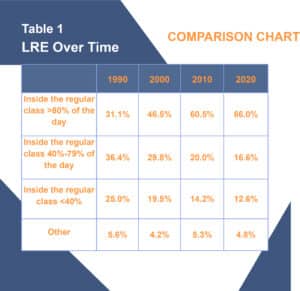
- National Progress: Annual reports to Congress on the implementation of IDEA show decades of growth for inclusive education.
Table 1 – LRE Over Time
https://nces.ed.gov/programs/digest/d23/tables/dt23_204.60.asp
- State Rankings: Nationally, Arizona ranks 26th for inclusion, with 69% of its students with disabilities spending over 80% of their day in a regular classroom. (That’s LRE Level A for those keeping track.) The data demonstrates wide variability. Alabama is first with 83% and New Jersey comes in last at 44%.
- By Disability: Inclusion varies widely by disability. This disparity between disability types exists nationally, and unfortunately, there has been little change over time.
Table 2. LRE by Disability
| 2022 | >80% | 40-79% | <40% |
| Speech or language impairment | 88.5 | 3.7 | 3.6 |
| Specific learning disability | 76.3 | 18.5 | 3.4 |
| Other health impairment | 70.7 | 17.9 | 7.5 |
| Visual impairment | 70.1 | 11.5 | 8.6 |
| Developmental delay | 68.8 | 14.9 | 14.7 |
| Hearing impairment | 65.2 | 13.5 | 9.7 |
| Orthopedic impairment | 58.9 | 15.0 | 19.1 |
| Emotional disturbance | 55.9 | 16.9 | 13.7 |
| Traumatic brain injury | 51.5 | 20.8 | 19.6 |
| Autism | 40.6 | 17.2 | 34.7 |
| Deaf blindness | 31.4 | 12.3 | 29.7 |
| Intellectual disability | 20.8 | 27.8 | 45.5 |
| Multiple disabilities | 16.0 | 18.2 | 43.5 |
https://nces.ed.gov/programs/digest/d23/tables/dt23_204.60.asp
- By Grade: Inclusion levels drop by grade. In 2023, 72% of Arizona kindergarteners with disabilities experienced Level A inclusion. By age 18, only 55% do.
- By District: Inclusion in Arizona varies by district and charter school. The LRE of each district and charter school (also known as public education agencies or PEAs) is reported to the federal government and posted publicly. Click here and select Indicator 5 to look up your district or charter school. Note that there are many spots with ‘*’ indicating that there are too few students to publicly report.Every state selects a target for all LRE levels and then must determine whether each PEA has met the target. Arizona’s target for the % of students who spend over 80% in regular classrooms is 69.63%. Of the 636 PEAs reported 533 met the target but 103 did not. It is interesting to note the wide variance in results.
Table 3. LRE Range
| Level A Indicator Range % | Number of AZ PEAs |
| 100 thru 91 | 276 |
| 90 thru 81 | 96 |
| 80 thru 71 | 86 |
| STATE TARGET | 69.63% |
| 70 thru 61 | 41 |
| 60 thru 51 | 27 |
| 50 thru 41 | 9 |
| 40 thru 31 | 5 |
| 30 thru 21 | 1 |
| 20 thru 11 | 0 |
*95 PEAs did not have enough data to report.
5 Ways Arizona Can Support Inclusion
Inclusive education is the best way to give children the chance to learn and develop the skills they will need to thrive. With a few strategic changes, Arizona can continue improving inclusion to transform students’ futures.
1. Strengthen the Role of Inclusion in State Accountability
Arizona has already taken the groundbreaking step to measure inclusion in the state’s school accountability system. The accountability system’s “special education inclusion component” rewards schools that exceed the state average of LRE Level A inclusion. The State Board adopted this metric based on research demonstrating positive outcomes for students in schools that increase the time special education students spend in general education classrooms. However, it only applies to K-8 schools and is worth just two points.
Next Step: The state board of education should consider extending the special education inclusion component to high schools and increasing its value in the accountability system.
2. Spotlight Success
Schools need to see and learn from examples of success. Virginia’s Inclusive Practices Partnership Project recognizes outstanding schools and educators who have embraced inclusive practices. The initiative also develops programs to ensure students with disabilities–especially those with more significant disabilities–have increased access to general education classrooms.
Next Step: The Department of Education could partner with community organizations to create an award spotlighting schools and educators embracing inclusive practices.
3. Add the LRE Indicator to School Report Cards
The Arizona Department of Education’s school report cards website provides critical information to the public while meeting the requirements of state and federal law. Including the least restrictive environment indicator to school report cards would offer even more valuable information to families and advocates.
Next Step: The department could also incorporate this information into the state report card with data disaggregated by disability.
- Create a Technical Assistance Center
The work of inclusion can be difficult, but it doesn’t have to be done alone. Some states have created organizations to offer an array of resources and support. Arizona could be next.
Next Step: Create a technical assistance center to assist districts, schools and educators. Consider the following examples:
- Florida Inclusion Network (FIN) at Florida State University
- Pennsylvania Training and Technical Assistance Network (PATTAN)
- Washington’s Inclusionary Practices Technical Assistance Network (IPTN)
- Require Schools to Self-Assess
Simply taking the time to self-assess helps schools to reflect on current practice and identify ways to support inclusion. In Virginia, state law requires school divisions to complete an Inclusive Practices Self-Assessment and Action Planning Form every three years. Assessment results go to the Virginia Department of Education (VDOE), the division’s superintendent, the special education director, the local school board, and the special education advisory committee. (The VDOE also offers a website of resources to assist with the process.)
Similarly, the Florida legislature requires that “once every 3 years, each school district and school shall complete a Best Practices in Inclusive Education (BPIE) assessment with a Florida Inclusion Network facilitator.”
Next Step: Arizona should consider requiring schools to regularly self-assess their progress toward inclusion.
For More Information: Indicator 5
Key Takeaway: Inclusion is the best predictor of academic success for students with disabilities. While inclusion in Arizona has improved, progress varies by disability. Students with intellectual disabilities still have the lowest rates. We have identified five straightforward ways Arizona can continue supporting inclusion to change lives.






Leave A Comment